Table of Contents
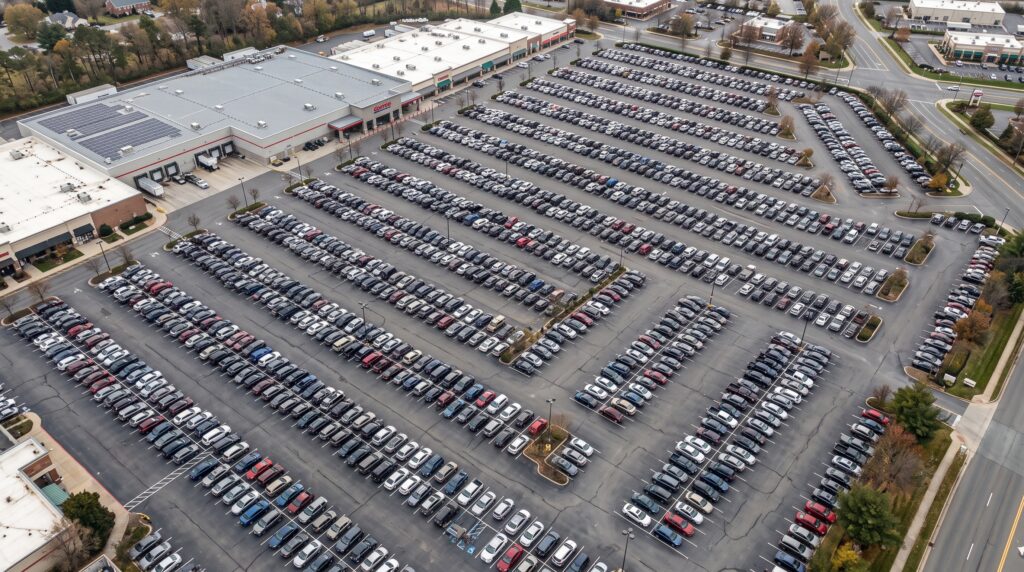
If your lot is full by 8:30 and the waitlist keeps growing, the instinct is to look for more stalls. But structured parking runs roughly $30,000 to $40,000 per stall, and that’s before permitting and years of build time.
Transportation demand management (TDM) takes a different approach. Instead of adding supply, it reduces the number of single-occupancy vehicles competing for the same lot. Your existing stalls serve more commuters, your waitlist shrinks, and you don’t pour a single yard of concrete.
Here’s how it works in practice, and why carpooling is one of the most effective TDM strategies for campuses, hospitals, and large worksites.
What Is Transportation Demand Management?
Transportation demand management is a set of strategies designed to reduce peak-hour vehicle trips by changing how people get to work. Common approaches include transit subsidies, flexible schedules, remote work policies, bike infrastructure, and carpooling programs.
The goal isn’t to punish drivers. It’s to give enough people a better alternative that fewer cars show up at the same time, freeing your existing lot to serve more people without building anything new.
Why Workplace Parking Is the Right Place to Start
Not every setting responds equally well to TDM. Workplace parking is an unusually good target for a few reasons:
Real financial incentive. A discounted or waived carpool permit is a meaningful cost saving for commuters, which is what drives opt-in and keeps people in the program.
One shared destination. Every commuter is heading to the same place at roughly the same time. That density is what makes ride-matching work where public rideshare apps fail.
Synchronized schedules. Shifts and class blocks cluster arrivals and departures, which is exactly when carpool pools fill fastest.
Weak transit alternatives. Campuses and large worksites are often off the main transit grid, so carpooling competes with solo driving, not a reliable train. That makes the case stronger.
The Limits of Standard Parking Management Strategies
Most organizations try some combination of these before considering TDM:
- Parking management software that tracks occupancy and automates permit queues. Useful for visibility, but it doesn’t reduce the number of cars.
- Price increases on permits. Reduces demand slowly and generates complaints before it generates stalls.
- Tighter enforcement. Addresses symptoms, not the imbalance between supply and demand.
- New construction. The most expensive option: $30,000–$40,000 per structured stall, plus years of approvals and build time.
None of these fundamentally solve a lot that has too many cars. TDM does, because it targets the cars themselves.
How a Carpool-Based Parking Management Program Works
The math is simple: two solo drivers who share a ride free up one stall. In a fully matched pilot of 250 waitlisted commuters, that’s the modeled equivalent of 250 stalls of freed-up capacity, without a permit, approval, or shovel. Real-world participation and match rates vary by site, which is exactly what a pilot is for.
What separates a parking management program that lasts from one that fades after launch:
Closed network. Restricting to work or campus email keeps the pool trusted and drives opt-in from people who wouldn’t touch a public rideshare app.
Smart matching. Pairing riders by home area and shift schedule means a viable ride actually exists.
Verified trips. Check-in on every shared ride prevents parking perk gaming and keeps your ROI numbers real, not modeled
Tracking. A participation dashboard gives procurement the data they need to justify scaling the program.

Carpooling as Sustainable Transportation
Carpooling is one of the lowest-effort sustainable transportation wins available to a large institution. Each verified shared ride directly reduces vehicle trips, tailpipe emissions, and lot congestion, with no capital investment.
For organizations with sustainability reporting requirements or ESG targets, a verified carpool program generates auditable data: trips reduced, estimated emissions avoided, and modal shift over time. That’s an impact that shows up in annual reports, not just press releases.
What to Ask a Parking Management Company Before You Sign
If you’re evaluating TDM partners or parking management solutions, the questions that matter most:
- Does it work for your commuter density and geography, or is it built for downtown transit corridors?
- Does it run alongside your existing permit or commuter program, or does it require replacing it?
- How are trips verified? Unverified trips mean parking perks get gamed and your ROI is fiction.
- What does the pilot look like? A credible partner starts bounded and low-risk, not a campus-wide contract on day one.
- Can it produce the reporting your parking and sustainability teams actually need?
- What employee data is collected, who can see it, and how long is it retained?
How CoTravel Fits a Transportation Demand Management Plan
CoTravel offers a closed, ID-verified carpool platform built specifically for campuses, hospitals, and worksites. It runs alongside your existing commuter or permit program, not as a replacement, and is designed for the institutional density where public rideshare apps consistently fail.
The pilot model: one site, one commuter cohort, set up end-to-end by CoTravel. CoTravel handles matching, trip verification, and a dashboard to track participation.
After a defined pilot period, you have real numbers to bring to procurement. For an organization sitting on a parking waitlist, it’s a low-risk way to test whether carpool-based TDM works for your site before committing further.
How is this different from a public rideshare app like Uber Carpool or Waze?
Public apps fail on institutional campuses because the rider pool is too diffuse. CoTravel restricts matching to a closed, verified network of people already going to the same site on the same schedule, which is the density public apps don’t have.
What are the most effective parking management strategies for campuses and hospitals?
Carpooling consistently outperforms other parking management strategies in institutional settings because commuters share one destination and arrive on similar schedules. Unlike transit subsidies (which require nearby service) or price increases (which generate complaints), a verified carpool program directly reduces cars on your lot and produces measurable ROI.
How much does it cost to build a structured parking stall?
Structured parking stalls typically cost $30,000 to $40,000 each to build, plus years of planning, approvals, and construction. A 250-stall parkade runs roughly $8.8M in capital alone before operating costs. Transportation demand management can serve the same waitlist for a fraction of that cost and go live this semester, not in five years.
Does this replace our existing parking permit system?
No. It’s designed to run alongside your current permit or commuter program, not replace it.
What if participation stays low?
Pilots are scoped to one site and one cohort specifically so the risk is bounded. Match rates and participation are visible on the live dashboard from week one, so you’re not waiting six months to find out if it’s working.
How do I start a workplace carpool program with CoTravel?
CoTravel starts with a bounded pilot: one site or commuter cohort, set up end-to-end by CoTravel. Your team sends one email to commuters and adds a short web listing. CoTravel handles matching, trip verification, and a live dashboard. After six months you have real numbers, participation rates, and cost savings to bring to procurement for a full rollout.