Heading to the coast and weighing the Kelowna to Vancouver bus against driving? A kelowna to vancouver carpool is usually the cheapest way to make the trip and the only one that puts you exactly where you are going. It is 390 km down the Okanagan Connector and the Coquihalla, and most drivers do it in about 4 hours 20 minutes, right up until the point where the Lower Mainland decides otherwise.
Westbound traffic on this corridor has its own character. UBC Okanagan students going home to the Lower Mainland, Okanagan residents travelling to Vancouver for specialist appointments, people connecting to international flights at YVR or catching a ferry to the Island, and anyone heading to a Canucks game or a concert at an arena the Okanagan does not have. This guide covers the distance, what the alternatives really offer, and how to find a seat.
How Far Is Vancouver from Kelowna?
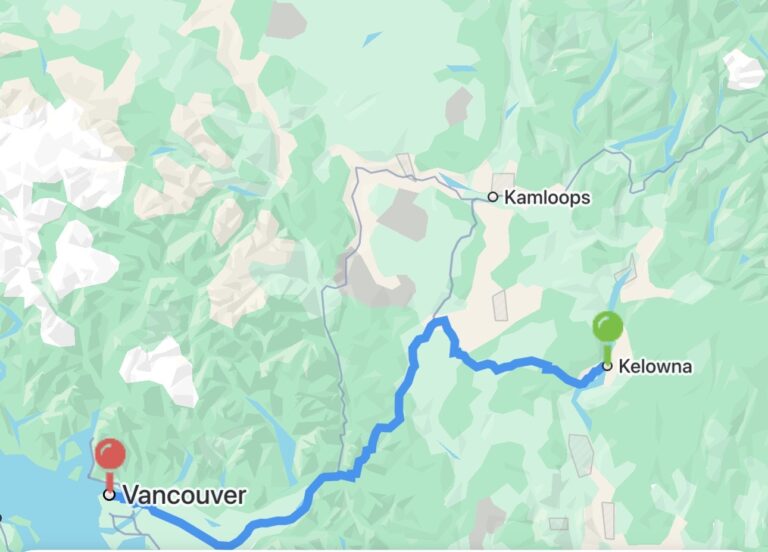
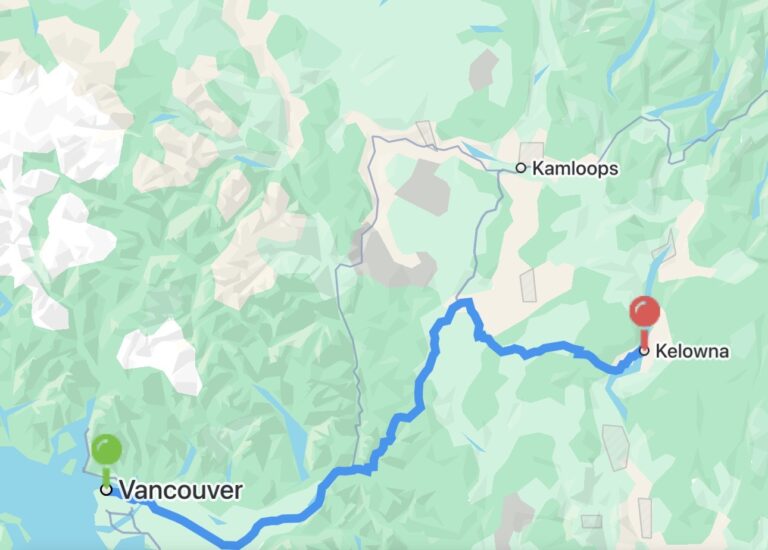
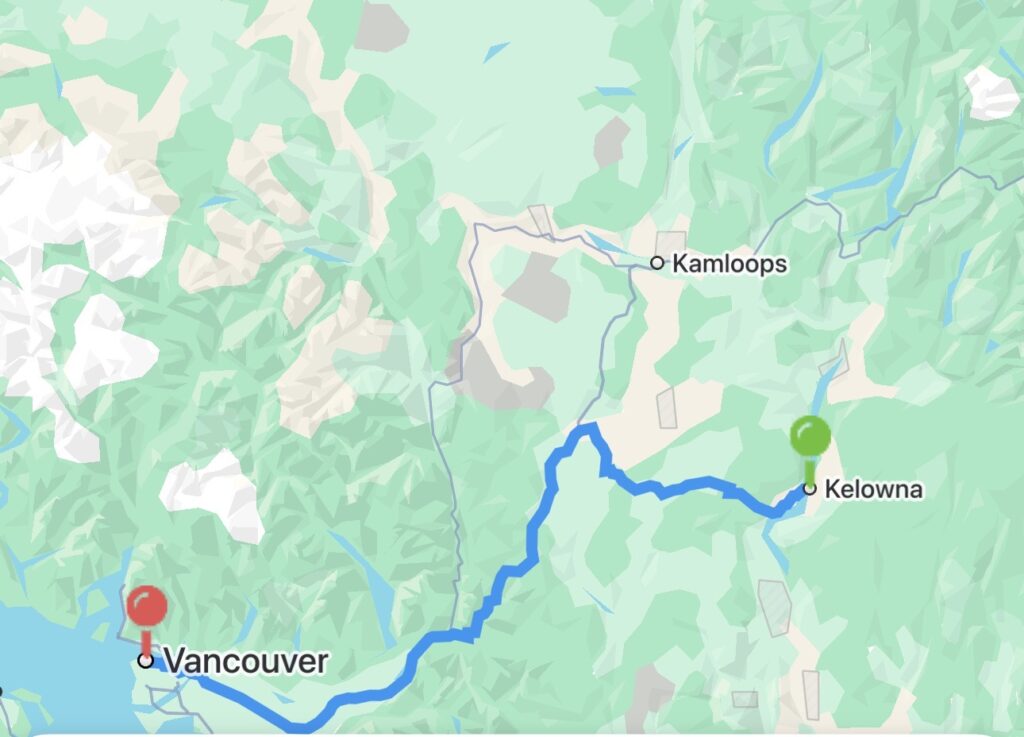
The kelowna to vancouver distance is about 390 km by road. Leaving Kelowna you cross the bridge into West Kelowna and climb onto Highway 97C, the Okanagan Connector, which tops out near 1,728 metres before dropping to meet Highway 5. From there it is the Coquihalla down to Hope, then Highway 1 west through the Fraser Valley into Metro Vancouver.
Kelowna to vancouver drive time is typically 4 to 4.5 hours, and the vancouver to kelowna distance is identical eastbound. Anyone asking how far is kelowna from vancouver should note that the number is the easy part. On this route the distance is fixed and the time is not.
The Last 40 km Are the Slowest
This is the thing that separates westbound from eastbound, and almost nobody plans for it.
The first 350 km are mountain highway and they behave predictably. The last stretch, from roughly Abbotsford in, is Metro Vancouver, and arriving in the late afternoon can add an hour to a four hour trip. Highway 1 through the Fraser Valley and across the Port Mann carries some of the heaviest commuter traffic in Canada, and a departure from Kelowna that felt sensible at 11 a.m. lands you in it precisely.
Drivers who run this route regularly leave early enough to be through the valley before three, or late enough to arrive after seven. That kind of judgement is difficult to apply from a bus timetable and easy to apply in a car, and it is one of the more practical reasons to travel with someone who does the drive often. When you book a ride, asking what time the driver plans to hit Abbotsford is a more useful question than asking when they leave.
There Is No Kelowna to Vancouver Train
Kelowna has no railway station. That is the whole answer to the kelowna to vancouver train question, and it has been true for decades. The Kettle Valley line that once served the region is now a rail trail and a heritage steam excursion, neither of which will take you to the coast.
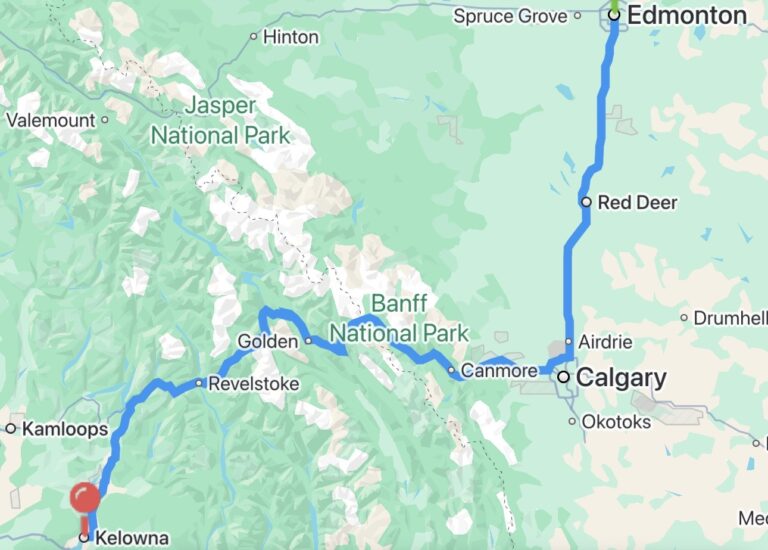
The nearest passenger rail is at Kamloops North, roughly 170 km north of Kelowna, where VIA Rail’s Canadian calls twice a week. Even if you made your way there, that service takes almost 13 hours to reach Vancouver and arrives at eight in the morning. Searches for a vancouver to kelowna train run into the hundreds each month, and the honest answer in both directions is that rail is not an option here at all.
How to Get from Vancouver to Kelowna, and Back Again
Four options exist in theory and three in practice. Here is how they compare for the westbound trip.
- Bus. Ebus, Red Arrow BC and Rider Express run roughly 11 departures a day. The kelowna to vancouver bus picks up at Kelowna West, downtown Lawrence Avenue or the airport, and sets down at Pacific Central Station. Fares generally sit between $63 and $80, and the fastest scheduled run is about 4 hours 40 minutes. The vancouver to kelowna bus mirrors it eastbound.
- Train. None. Covered above.
- Flight. YLW to YVR is under an hour in the air and the route is heavily served. It is also the most expensive option, and for anything other than a connection it rarely justifies itself once you add bags and two airport transfers.
- Carpool. A share of the actual driving cost, a departure time you agreed to, and a drop off at the address you are going to rather than a terminal.
The question of how to get from vancouver to kelowna gets asked far more often than the reverse, but the westbound trip is the harder one to plan, because arrival timing matters and a terminal on Station Street is rarely where anybody actually needs to be.
Connections: YVR, the Ferries and the Island
A large share of westbound trips on this corridor do not end in Vancouver. They continue.
YLW handles a good deal of domestic traffic, but most international itineraries route through YVR, so Okanagan travellers regularly drive four hours to catch a long haul flight. Others are heading for Tsawwassen or Horseshoe Bay to cross to Vancouver Island, or connecting onward to Whistler or Seattle.
That changes what a good trip looks like. If your flight leaves YVR at 7 a.m., a bus arriving at Pacific Central the previous evening means paying for a hotel, while a shared car leaving Kelowna at midnight does not. If you are catching a ferry, being dropped at the terminal rather than downtown saves a transit leg with luggage. It is worth telling a driver where you are actually going, because on this route the destination after Vancouver is often the point.
What the Drive Costs
The drive from kelowna to vancouver burns roughly 35 litres of fuel, which at BC pump prices, reliably the highest in the country, is somewhere around $55 to $70 one way. The drive from vancouver to kelowna costs the same going back.
The Connector and the Coquihalla add wear that flat highway does not. Sustained climbs and long descents are hard on brakes, elevation pushes consumption up, and the true cost of running a car is several times the fuel bill once depreciation, insurance and maintenance are counted. Split two or three ways it stops being a consideration.
Leaving in Sunshine, Arriving in Snow
From October 1 to April 30, winter tires are legally required on both Highway 97C and Highway 5. Both cross mountain passes, so they carry the extended date range rather than the March 31 cutoff used on most BC highways.
Westbound has a particular trap. Kelowna sits in a valley with a mild, dry climate, and it is entirely normal to leave the city on clear pavement and be in serious snow within forty minutes of climbing onto the Connector at 1,728 metres. People who have not driven it underestimate that gap constantly. The Coquihalla behaves the same way, and closures on either can strand you for hours.
The carpooling point is practical rather than moral. A driver who runs this pass through the winter has the tires, watches the road reports before leaving, and knows that conditions in Kelowna tell you nothing about conditions at the summit.
Parking Is the Expensive End of This Trip
Eastbound, parking is barely worth mentioning. Westbound it is one of the main costs of the journey, because Vancouver has some of the most expensive parking in the country.
Metered street parking downtown runs up to $7 an hour, parkades in the core charge accordingly, and if you drive yourself in for a few days the parking can quietly exceed what the fuel cost. If you are flying onward, YVR long term parking is its own bill on top of the drive. Even a weekend visit means finding and paying for a space in a city where residents struggle to do the same.
A carpool passenger pays none of it. The driver parks where they always park because they were coming anyway, and you are dropped at the door of wherever you are staying. On this route that saving alone can be worth more than the seat.
Four Hours, and Who Is In the Car
The westbound passenger list is not the same as the eastbound one. Eastbound is largely people going to the Okanagan for something pleasant. Westbound is more often people going to Vancouver because they have to.
UBC Okanagan draws heavily from the Lower Mainland, so a large share of its students travel this way at reading week and the end of term. Okanagan residents go to Vancouver for specialist care the Interior cannot provide. Others are travelling for work, for a flight, for a hospital appointment, or to see family. Mixed in are the people doing it for a Canucks game or a show, because the Okanagan has no venue that size.
That makes for a more varied car than you might expect, and four hours is long enough to have an actual conversation. For students especially, a shared drive is one of the simpler ways to know somebody at the far end before you get there.
When There Is No Car and No Transit Option
Nothing connects the Okanagan to the Lower Mainland by regional transit. There is no rail. What replaced Greyhound after it left western Canada in 2018 is thinner and more expensive than what came before.
That leaves students without vehicles, newcomers who have not yet converted a licence, people who cannot afford a car in one of the country’s most expensive regions, older travellers who have stopped driving long distances, and anyone whose licence is temporarily unavailable. The medical case is the sharpest: patients travelling to Vancouver for treatment, often unable to drive themselves home afterwards, on a route where the bus runs to a terminal nowhere near the hospitals.
A carpool closes that gap directly, and it closes it door to door, which on a day when you are unwell is the part that matters.
390 km, Shared
A solo drive from Kelowna to Vancouver puts roughly 80 kg of CO2 into the air one way. Two people making the trip separately doubles it. Three in one car does not.
That is the whole mechanism, and it needs no new technology and no change of route. Four people sharing one car instead of taking four keeps around 240 kg out of the atmosphere on a single westbound run, and for students travelling home each term it repeats several times a year.
It also takes cars off the Coquihalla and out of the Fraser Valley at exactly the hours both are worst.
How the Kelowna to Vancouver Rideshare Works on CoTravel
CoTravel matches drivers already making the trip with passengers heading the same way. Drivers post their route, seats and departure time. Passengers book the seat that fits.
- Verified profiles. Every member verifies their identity before booking or posting.
- Cost sharing, not fares. Drivers offset fuel rather than run a business.
- You choose the ride. Departure time, pickup point, seats available, and who you travel with.
- In app messaging. Confirm the drop off before the day, which matters more westbound than east.
- Ratings both ways. Drivers and passengers rate each other after every trip.
Two things are worth doing here. Ask when the driver expects to reach the Fraser Valley rather than only when they leave Kelowna, and tell them where you are actually headed, because a driver continuing to YVR, a ferry terminal or the North Shore may be able to take you the whole way. Term start and end are the busiest periods in both directions, so book earlier around those weeks.
Kelowna to Vancouver Carpool FAQ
How far is Vancouver from Kelowna?
The kelowna to vancouver distance is about 390 km by road. The route leaves Kelowna across the bridge into West Kelowna, climbs Highway 97C, the Okanagan Connector, joins Highway 5, the Coquihalla, down to Hope, then follows Highway 1 through the Fraser Valley. Kelowna to vancouver drive time is typically 4 to 4.5 hours, though Metro Vancouver traffic can add an hour on the final stretch.
Is there a bus from Kelowna to Vancouver?
Yes. Ebus, Red Arrow BC and Rider Express run roughly 11 departures a day between them. The kelowna to vancouver bus picks up at Kelowna West, downtown Lawrence Avenue or Kelowna Airport and arrives at Pacific Central Station. Fares generally sit between $63 and $80, with the fastest scheduled run around 4 hours 40 minutes. The vancouver to kelowna bus runs the same corridor eastbound.
Is there a train from Kelowna to Vancouver?
No. Kelowna has no railway station and has had no passenger service for decades, so there is no kelowna to vancouver train and no vancouver to kelowna train. The old Kettle Valley line is now a rail trail and a heritage excursion. The nearest passenger rail is Kamloops North, about 170 km away, where VIA Rail’s Canadian calls twice a week and takes almost 13 hours to reach Vancouver.
What is the best time to leave Kelowna for Vancouver?
Aim to clear the Fraser Valley outside the afternoon peak. The drive from kelowna to vancouver is predictable for the first 350 km, but Highway 1 from around Abbotsford into Metro Vancouver carries heavy commuter traffic and can add an hour to the trip. Drivers who know the route tend to be through the valley before three in the afternoon or arrive after seven in the evening.
Do I need winter tires to drive from Kelowna to Vancouver?
Yes, between October 1 and April 30. Both Highway 97C and Highway 5 cross mountain passes, so they carry the extended winter tire requirement rather than the March 31 date used on most BC highways. The Okanagan Connector reaches about 1,728 metres, and it is common to leave Kelowna on dry pavement and hit heavy snow within forty minutes.
How much does a Kelowna to Vancouver carpool cost?
A carpool seat is a share of the real cost of the drive rather than a commercial fare. Fuel alone runs roughly $55 to $70 one way, so a shared seat usually comes in below the $63 to $80 the bus charges while still taking you door to door. The exact figure depends on how many seats the driver is filling.
Can I get a ride to YVR or the ferry terminal?
Often yes, and it is worth asking. Many westbound trips on this corridor continue to an international flight at YVR or a sailing from Tsawwassen or Horseshoe Bay, so drivers are frequently heading that way themselves. Message the driver before booking to confirm the drop off point, particularly for early flights, where leaving Kelowna overnight avoids paying for a hotel near the airport.