Weighing the Vancouver to Kelowna bus against driving yourself, or eyeing a flight to save a few hours? On a route this weather dependent, a vancouver to kelowna carpool usually beats all three on cost, and it drops you closer to where you actually want to be. The drive covers roughly 390 km through the Coquihalla and over the Okanagan Connector, with most trips taking about 4 hours and 20 minutes in clear conditions.
This is one of British Columbia’s busiest intercity corridors, and demand runs hard in both directions. UBC Okanagan students heading back to the Lower Mainland, Vancouverites chasing Okanagan summers and Big White ski weekends, and the steady flow of people relocating east for housing they can afford all keep seats moving. This guide covers what the trip really costs, how the bus, train and flight compare, and how to find a seat going either way.
How Far Is Kelowna from Vancouver?
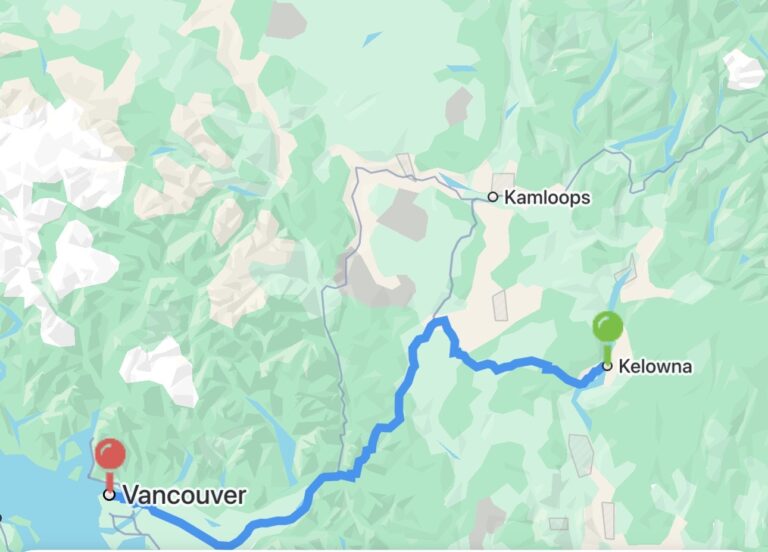
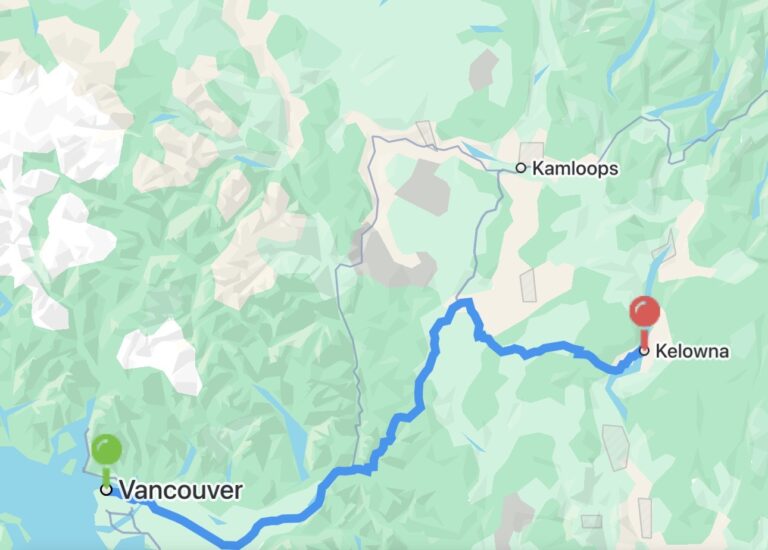
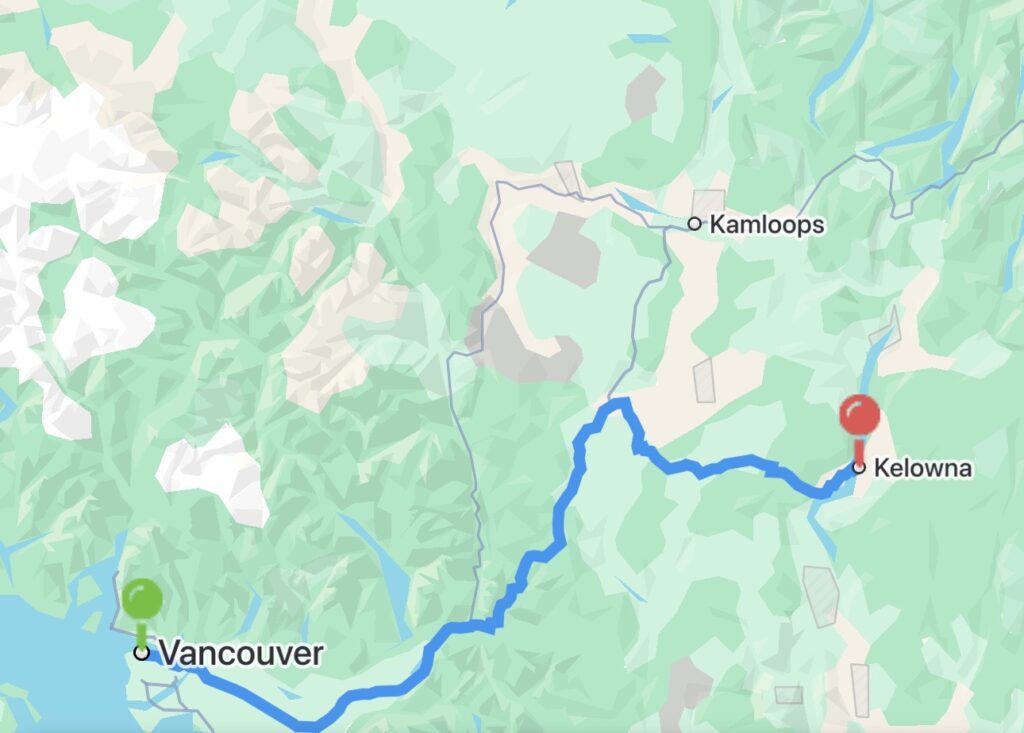
The vancouver to kelowna distance is about 390 km by road. The standard route runs east on Highway 1 out of Vancouver through the Fraser Valley, north on Highway 5 from Hope, then east on Highway 97C, the Okanagan Connector, which drops down into West Kelowna and across the bridge into the city.
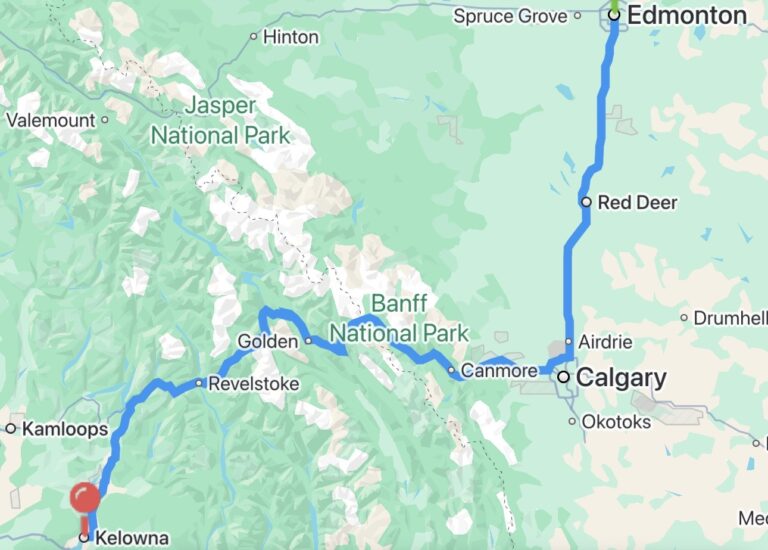
Kelowna to vancouver drive time is typically 4 to 4.5 hours without long stops, and the kelowna to vancouver distance is identical in reverse. People often ask how far is vancouver from kelowna expecting a bigger number, because the mountain scenery makes it feel longer than it is. In practice it is a comfortable half day drive, more than 200 km shorter than the run from Calgary.
How to Get from Vancouver to Kelowna: Bus, Train, Flight or Carpool
There are four realistic answers to how to get from vancouver to kelowna, and they trade cost, time and flexibility against each other differently.
- Bus. Ebus, Red Arrow BC and Rider Express run roughly 11 departures a day out of Pacific Central Station. Fares typically start around $63 one way and average closer to $80. The fastest scheduled run is about 4 hours 40 minutes; most take 5 to 6 hours depending on whether you are set down at Kelowna West, downtown Lawrence Avenue or the airport.
- Train. There is none. More on that below.
- Flight. YVR to YLW is about an hour in the air and one of the busiest short haul routes in western Canada. It is also the priciest option once you add bags, airport parking and the trips to and from two airports.
- Carpool. You split the real cost of the drive with someone already making it, leave at a time you both agree on, and get dropped closer to your actual destination.
Why There Is No Vancouver to Kelowna Train
Searches for a vancouver to kelowna train run into the hundreds every month, and the answer never changes: no passenger rail serves Kelowna. There is no station, and there has been no scheduled passenger service into the central Okanagan for decades. The old Kettle Valley line survives as a rail trail and a heritage steam excursion, not as transportation.
The closest substitute is VIA Rail’s Canadian, which calls at Kamloops North twice a week on its way between Vancouver and Toronto. From there you would still need a bus or a ride to cover the last 170 km south. Anyone hunting for a kelowna to vancouver train is realistically choosing between the bus, a flight, or a shared car.
What the Drive from Vancouver to Kelowna Really Costs
The drive from vancouver to kelowna burns roughly 35 litres of fuel each way in an average car. At BC pump prices, reliably the highest in the country, that lands somewhere around $55 to $70 one way before anything else.
Then there are the costs people leave out of the mental arithmetic. Tires wear. Oil intervals arrive sooner. The Coquihalla and the Connector are hard on brakes. The true cost of running a car is several times the fuel bill alone once depreciation, insurance, tires and maintenance are counted, which is why the drive from kelowna to vancouver always feels more expensive than the receipt at the pump suggests.
Split the fuel two or three ways and the trip stops being a line item worth worrying about.
Door to Door, the Flight Is Not as Fast as It Looks
An hour in the air is a persuasive number. The door to door version is less flattering.
Getting to YVR from most of Vancouver takes 30 to 60 minutes. Airlines want you there well ahead of a domestic departure. Then comes boarding, the flight, deplaning, waiting on bags, and the 15 minute drive from YLW into downtown Kelowna. Add it up honestly and you land near 4 hours, which is roughly what the drive takes anyway.
The bus has the same problem in a different shape. Pacific Central Station is nowhere near most Vancouver neighbourhoods, you are tied to a 6:30 am or 2:15 pm departure, and the schedule builds in rest stops. A carpool leaves from an agreed point at an agreed time and drives the 390 km directly. On a corridor where every option finishes within about an hour of the others, the one that does not make you wait around is the one that saves you time.
Winter Tires and the Okanagan Connector
From October 1 to April 30, winter tires are legally required on both Highway 5 and Highway 97C. Both cross mountain passes, so they fall under the extended date range rather than the March 31 cutoff that covers most BC highways. Enforcement is real, and so is the reason behind it.
The Okanagan Connector tops out around 1,728 metres, one of the highest stretches of highway in the province. It collects snow while Vancouver is getting rain, and conditions at the summit routinely bear no resemblance to conditions at either end. The Coquihalla is no gentler. Closures happen, sometimes for hours.
This matters for carpooling in a specific way. A driver who runs this route through the winter has the right tires and knows what the Connector does in a squall. If you do not drive it often, riding with someone who does is simply the safer version of the trip.
Parking at Both Ends
Vancouver has some of the most expensive parking in the country. Metered street parking downtown runs up to $7 an hour, and monthly permits in central parkades run well into the hundreds. If you are leaving a car behind to fly or take the bus, YVR long term lots add up quickly over a weekend.
Kelowna is cheaper but not free. The city meters downtown streets and runs paid lots near the waterfront and the cultural district, and demand climbs through the summer, exactly when most people are visiting.
A carpool sidesteps the question entirely. The driver was making the trip anyway and parks where they always park. The passenger never pays for a space at either end. On a weekend trip that saving alone can be worth more than the ride.
Four Hours Is a Long Time to Sit in Silence
Four and a half hours alone in a car is four and a half hours of your own radio and your own thoughts. Plenty of people prefer it that way. Plenty do not.
This corridor has an unusually mixed passenger list. UBC Okanagan students heading to the coast for reading week. People who moved to Kelowna for housing they could actually afford and still travel back for work. Skiers heading for Big White in February and wine tourists in September. Nurses and tradespeople working rotations at both ends.
Carpooling turns dead time into something better. Conversations that start on the Coquihalla have a way of carrying on past the drop off. For newcomers and anyone who has just relocated, a shared drive is one of the few genuinely low pressure ways to meet people who live where you are going.
When There Is No Car and No Transit Option
Not everyone has the option of driving. Students, newcomers who have not yet transferred a licence, people who cannot afford a car in one of the most expensive housing markets in Canada, older travellers who have stopped driving, and anyone whose licence is temporarily out of play all need this route solved without a vehicle.
Transit does not solve it. There is no regional transit link between the Lower Mainland and the Okanagan. After Greyhound left western Canada in 2018, what replaced it was thinner and more expensive. The bus works if your timing matches its timing and your destination sits near one of its Kelowna stops. If it does not, you are looking at a very expensive taxi or asking someone for a favour.
A carpool closes that gap directly. It is often the difference between being able to make a family visit, a medical appointment or a job interview and not being able to go at all.
390 km, Shared
A solo drive from Vancouver to Kelowna puts roughly 80 kg of CO2 into the air one way, based on what an average car burns over 390 km. Two people driving separately doubles it. Three people in one car does not.
That is the entire mechanism. Carpooling does not ask for a different vehicle or a different route, just fewer cars making the same trip. Four people sharing one car instead of taking four keeps something like 240 kg out of the atmosphere on a single one way run.
It also takes cars off the Coquihalla, which anyone who has queued at the Hope on ramp on a long weekend will appreciate.
How the Vancouver to Kelowna Rideshare Works on CoTravel
CoTravel matches drivers already making the trip with passengers heading the same way. Drivers post their route, seats and departure time. Passengers book the seat that fits their day.
- Verified profiles. Every member verifies their identity before booking or posting.
- Cost sharing, not fares. Drivers offset fuel rather than run a business.
- You choose the ride. Departure time, pickup point, seats available, and who you are travelling with.
- In app messaging. Sort out the meeting point and details before the day.
- Ratings both ways. Drivers and passengers rate each other after every trip.
Because this corridor runs busy in both directions, the return leg is usually as easy to fill as the outbound. Post a Kelowna to Vancouver seat and it tends to move quickly, particularly on Sunday evenings and at the end of reading week.
Vancouver to Kelowna Carpool FAQ
How far is Kelowna from Vancouver?
The vancouver to kelowna distance is about 390 km by road. The usual route runs east on Highway 1 through the Fraser Valley, north on Highway 5 (the Coquihalla) from Hope, then east on Highway 97C, the Okanagan Connector, into West Kelowna and across the bridge. Kelowna to vancouver drive time is typically 4 to 4.5 hours without long stops.
Is there a bus from Vancouver to Kelowna?
Yes. Ebus, Red Arrow BC and Rider Express together run roughly 11 departures a day from Pacific Central Station. Fares generally start around $63 one way and average closer to $80. The fastest scheduled service takes about 4 hours 40 minutes, while most runs take 5 to 6 hours depending on the drop off point. The kelowna to vancouver bus runs on a similar schedule in reverse, with stops at Kelowna West, downtown Lawrence Avenue and Kelowna Airport.
Is there a Vancouver to Kelowna train?
No. There is no passenger rail service to Kelowna and no station in the city. Anyone searching for a vancouver to kelowna train or a kelowna to vancouver train is choosing between the bus, a flight or a shared car. The nearest passenger rail is VIA Rail’s Canadian, which stops at Kamloops North twice a week, leaving another 170 km to cover by road.
How long is the drive from Vancouver to Kelowna?
Plan on 4 to 4.5 hours in clear conditions. The drive from vancouver to kelowna is about 390 km and the route is mostly divided highway, but winter weather on the Coquihalla and the Okanagan Connector can add significant time or close the road entirely. Long weekend traffic through Hope also slows things down.
Do I need winter tires to drive from Vancouver to Kelowna?
Yes, between October 1 and April 30. Both Highway 5 and Highway 97C cross mountain passes, so they carry the extended winter tire requirement rather than the March 31 date that applies to most BC highways. The Okanagan Connector reaches about 1,728 metres and gets snow long after the coast has moved on.
How much does a Vancouver to Kelowna carpool cost?
A carpool seat is a share of the real cost of the drive rather than a commercial fare, so it usually comes in well under the $63 to $80 range the bus charges and far below a flight once bags and airport parking are counted. The exact amount depends on how many seats the driver is filling.
Is carpooling from Vancouver to Kelowna safe?
CoTravel verifies every member before they can post or book a trip, and drivers and passengers rate each other after the ride. You can message through the app beforehand to agree on a pickup point and confirm details. On a winter mountain route there is also an argument that riding with an experienced driver who runs the Connector regularly is safer than driving it yourself for the first time.