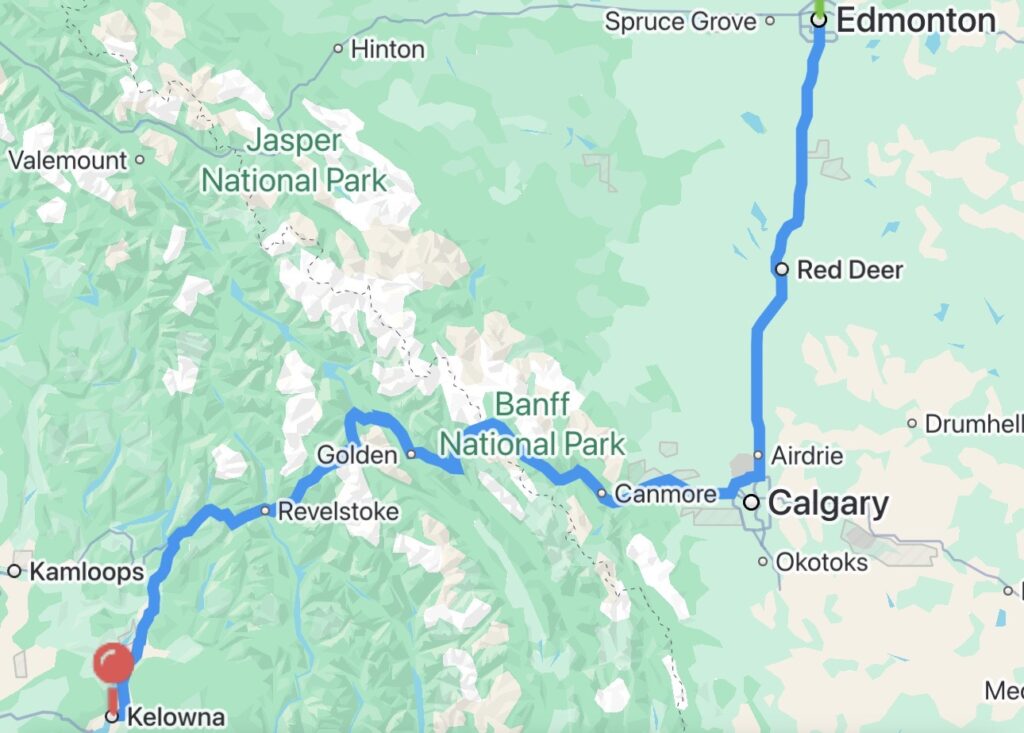
Looking at the Edmonton to Kelowna bus and wondering if the drive is the better call? On a trip this long the answer is usually yes, and an edmonton to kelowna carpool is the cheapest version of it. There is no direct bus on this route, the drive runs close to 900 km, and most people cover it in about 9 hours 40 minutes.
This corridor carries a particular kind of traffic. Albertans have owned recreational property in the Okanagan for generations, Edmontonians head west for wine country in the autumn and Big White in the winter, and students move between the two provinces every term. It is a long day behind the wheel in either direction, which is exactly why sharing it makes sense. This guide covers both driving routes, what the bus actually involves, and how to find a seat.
How Far Is Kelowna from Edmonton?
The edmonton to kelowna distance is about 892 km by the standard route. Edmonton to kelowna drive time is roughly 9 hours 40 minutes without long stops, which realistically means a full day once you add fuel, food and a leg stretch. The kelowna to edmonton distance is the same coming home, and the distance from kelowna to edmonton varies only by which way you choose to go.
That last point matters more here than on most routes, because there are genuinely two sensible ways to make this drive. Anyone asking how far is kelowna from edmonton is really asking about one of two different trips.
Two Ways to Drive from Edmonton to Kelowna
Most route planners will send you one way, but the drive from edmonton to kelowna splits into two viable options with a real tradeoff between them.
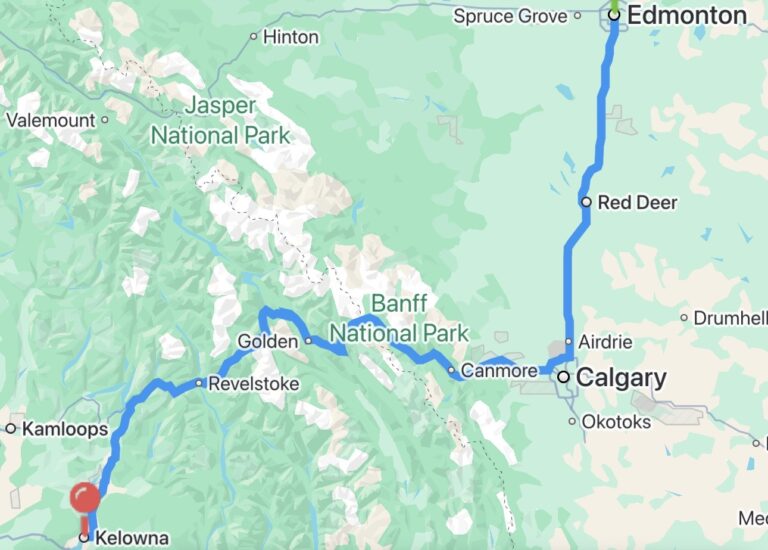
- Via Calgary and Revelstoke, about 892 km and 9 hours 40 minutes. Highway 2 south to Calgary, then the Trans-Canada west through Banff, Golden and Revelstoke to Sicamous, then Highway 97A south into the Okanagan. Shorter and faster, with more services along the way, but it crosses Kicking Horse Pass and Rogers Pass and it puts you on the busiest stretch of mountain highway in the country.
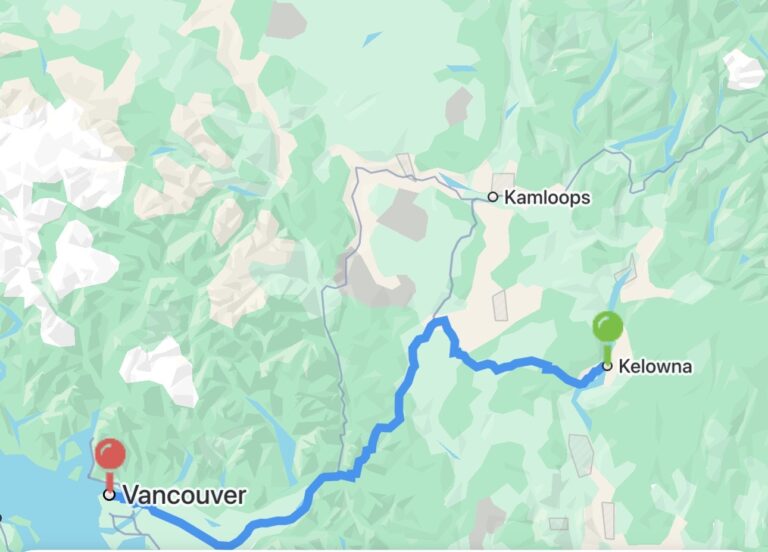
- Via Jasper and Kamloops, about 969 km and 10.5 hours. The Yellowhead west past Miette Hot Springs and through Jasper, then south through Clearwater to Kamloops and on to Vernon before joining Highway 97A. Roughly 77 km longer and about an hour slower, but quieter, and it avoids Rogers Pass entirely.
The southern route wins on time in good conditions. The northern route becomes the better choice when Rogers Pass is closed for avalanche control, which happens regularly through the winter, and drivers who run this corridor often decide between the two on the morning of the trip based on road reports.
There Is No Direct Edmonton to Kelowna Bus
This is the part most people discover after they have already started pricing tickets. There is no single bus that takes you from Edmonton to Kelowna.
Rider Express sells the journey, but their own routing breaks it into three separate buses: Edmonton to Calgary, Calgary to Salmon Arm, then Salmon Arm to Kelowna. That is two transfers, two waits at intermediate depots, and three chances for a connection to slip. The Edmonton to Calgary leg alone runs about 4 hours 15 minutes.
The kelowna to edmonton bus has the same structure in reverse. None of this makes the operators the problem. It reflects what happened to intercity coach service in western Canada after Greyhound pulled out in 2018, and it is simply the reality of the route. A carpool covers the same ground in one vehicle with nobody to reconnect with.
What the Drive Really Costs
The drive from edmonton to kelowna burns roughly 79 litres of fuel each way in an average car. Across Alberta and BC pump prices that lands somewhere near $115 to $135 one way, and you are doing it twice.
Then there is everything the fuel gauge does not show. Nearly 900 km of mountain highway is hard on brakes and tires, service intervals arrive faster, and the true cost of running a car is several times the fuel bill once depreciation, insurance and maintenance are counted. A round trip on this route is a real expense however you account for it.
Split three ways, the fuel becomes a rounding error on a weekend away. That is the whole argument.
Ten Hours Is a Long Day, and the Flight Is Not the Escape It Looks Like
WestJet flies Edmonton to Kelowna directly and the flight is a little over an hour, which sounds decisive until you cost it out. Add the fare, bags, getting to YEG, arriving early for a domestic departure, and then sorting out transport at the Kelowna end, and for most people it is the most expensive option by a wide margin. Whether it is worth it depends entirely on what your time is worth and whether you need a car once you arrive.
That last point catches people out. The Okanagan is spread along a lake with limited transit, so flying in usually means renting a car anyway, and rental rates in Kelowna climb steeply in summer. Arriving in someone else’s car with a lift already sorted sidesteps that entirely.
Against the bus, the comparison is simpler. Three buses and two transfers against one car leaving when you want to leave is not a close contest on time.
Winter Tires and the Passes
From October 1 to April 30, winter tires are legally required on the BC mountain sections of both routes. Highway 1 through Kicking Horse Pass and Rogers Pass carries the extended date range rather than the March 31 cutoff used on most BC highways, and enforcement is real.
Rogers Pass is among the most avalanche prone highway corridors in North America. Parks Canada runs active control through the winter and closes the road, sometimes for hours, while crews bring slopes down deliberately. This is the single biggest variable on the southern route, and it is the reason the Jasper option exists as a genuine alternative rather than a scenic detour.
The practical carpooling point is straightforward. A driver who runs this corridor through the winter has proper tires, watches the road reports, and knows when to switch routes. If you have not driven Rogers Pass in February, riding with someone who has is the sensible version of the trip.
Parking at Both Ends
If you drive yourself, you are paying to leave a car somewhere at both ends of the trip. Downtown Edmonton parking is not cheap, and in Kelowna the city meters its downtown streets and runs paid lots near the waterfront and the cultural district, with demand climbing through the summer, exactly when most Albertans are visiting.
Fly instead and the problem moves rather than disappears. YEG long term parking adds up quickly across a week, and then you are renting at the other end.
A carpool removes the question completely. The driver was making the trip anyway and parks where they always park. The passenger pays for nothing at either end, and on a week in the Okanagan that difference is not small.
Nobody Should Drive Ten Hours Alone
Nearly ten hours is not a commute, it is an endurance event. Driver fatigue on long mountain highways is a genuine safety issue, not a comfort complaint, and the last two hours into the Okanagan come after you have already crossed two passes.
Two drivers sharing the wheel changes the trip entirely. Even one passenger who stays awake and talks makes a measurable difference on a stretch this long. The mix on this route helps: students moving between provinces at the start and end of term, families with Okanagan property, retirees heading somewhere warmer for the winter, and seasonal workers following orchard and hospitality jobs.
Conversations that start somewhere around Red Deer have a long time to develop. For people who have just moved between the two provinces, a shared drive is one of the easier ways to arrive already knowing somebody.
When There Is No Car and No Transit Option
This route is close to impossible without a vehicle. Students without cars, newcomers who have not yet converted a licence, older travellers who no longer drive long distances, people who cannot afford a car, and anyone whose licence is temporarily unavailable all still need to make this trip.
The alternatives do not really serve them. There is no regional transit between Alberta and the Okanagan, no passenger rail into Kelowna at all, and the bus means three separate coaches with two transfers. Flying is the only clean option and it is the most expensive one, which puts it out of reach for exactly the people who most need an alternative.
A carpool fills that gap directly. On a corridor this long it is often the difference between making a family visit, a medical appointment or a move between provinces and not going at all.
892 km, Shared
A solo drive from Edmonton to Kelowna puts roughly 180 kg of CO2 into the air one way, based on what an average car burns across 892 km. Two people driving separately doubles it. Three people in one car does not.
That is the entire mechanism, and the longer the route the more it matters. Four people sharing one vehicle instead of taking four keeps something in the order of 540 kg out of the atmosphere on a single westbound run, which is more than most short haul flights per passenger.
It also puts fewer cars on the Trans-Canada through the passes, where a single incident can hold traffic for hours in both directions.
How the Edmonton to Kelowna Rideshare Works on CoTravel
CoTravel matches drivers already making the trip with passengers heading the same way. Drivers post their route, seats and departure time. Passengers book whichever ride fits.
- Verified profiles. Every member verifies their identity before booking or posting.
- Cost sharing, not fares. Drivers offset fuel rather than run a business.
- You choose the ride. Departure time, pickup point, seats available, and who you travel with.
- In app messaging. Agree the meeting point, the route and stops before the day.
- Ratings both ways. Drivers and passengers rate each other after every trip.
On a route this long it is worth messaging before you book. Ask which of the two routes the driver plans to take, whether they intend to break the trip, and how they want to handle stops. Drivers heading through Calgary may also have room for someone travelling only part of the way, so partial legs are worth searching for in both directions.
Edmonton to Kelowna Carpool FAQ
How far is Kelowna from Edmonton?
The edmonton to kelowna distance is about 892 km by the standard route through Calgary and Revelstoke. Edmonton to kelowna drive time is roughly 9 hours 40 minutes without long stops. The alternative route via Jasper and Kamloops is about 969 km and takes closer to 10.5 hours.
What is the best route to drive from Edmonton to Kelowna?
Two routes work. The southern option runs Highway 2 to Calgary, the Trans-Canada west through Banff, Golden and Revelstoke to Sicamous, then Highway 97A into Kelowna. It is shorter at 892 km but crosses Kicking Horse Pass and Rogers Pass. The northern option follows the Yellowhead through Jasper, then south via Clearwater, Kamloops and Vernon. It is about 77 km longer and an hour slower, but avoids Rogers Pass, which makes it the better choice when avalanche control closes the southern route.
Is there a direct bus from Edmonton to Kelowna?
No. There is no single bus covering the route. Rider Express sells the journey as three separate buses: Edmonton to Calgary, Calgary to Salmon Arm, then Salmon Arm to Kelowna, which means two transfers. The Edmonton to Calgary leg alone takes about 4 hours 15 minutes. The kelowna to edmonton bus follows the same pattern in reverse.
Is there a train from Edmonton to Kelowna?
No. Kelowna has no passenger rail service and no station, so no train reaches it from anywhere. Edmonton is served by VIA Rail’s Canadian, but that line runs west to Jasper and Vancouver rather than into the Okanagan. The realistic options are driving, flying, the multi leg bus, or a carpool.
Do I need winter tires to drive from Edmonton to Kelowna?
Yes, on the BC portions between October 1 and April 30. Both routes cross mountain passes, so they carry the extended winter tire requirement rather than the March 31 date used on most BC highways. Rogers Pass on the southern route is actively managed for avalanches and closes periodically through the winter.
How much does an Edmonton to Kelowna carpool cost?
A carpool seat is a share of the real cost of the drive rather than a commercial fare. Fuel alone runs roughly $115 to $135 one way for the full 892 km, so splitting it between three or four people brings the per person cost well below the bus once you account for the transfers, and far below flying.
Is carpooling from Edmonton to Kelowna safe?
CoTravel verifies every member before they can post or book a trip, and drivers and passengers rate each other after each ride. You can message through the app beforehand to agree on a pickup point and confirm the route. On a drive approaching ten hours there is also a strong case that sharing the wheel with another driver is safer than attempting it alone.