Plenty has been written about moving to British Columbia. Far less is written about the ordinary Tuesday six weeks later, when the boxes are gone, the job has started, and you need to get to Kelowna for something that will not wait.
This is about that part. What living in british columbia actually costs once you need to move around it, where the transit reaches, and what to do about the very large gaps in between.
What it costs before you add a car
The cost of living in British Columbia is the number most people arrive already braced for. Monthly costs in 2026 run from roughly $3,500 to more than $8,800 depending on household size and location, and housing is the bulk of it. A one-bedroom in Vancouver averages about $2,530, which is second only to Toronto nationally. Inside the city centre that rises to around $3,220. Outside it, closer to $1,610.
Those figures are widely quoted, and most guides to moving to BC stop right there. What gets left out of the cost of living in BC breakdowns is the transport line, and in this province it is unusually easy to get wrong.
The ICBC mistake that costs newcomers thousands
British Columbia runs public auto insurance through ICBC, and a driver with no recorded history is quoted around $3,194 a year. Many people relocating to BC see that number, accept it, and start paying it.
You often do not have to. ICBC will credit up to 15 years of driving experience earned outside British Columbia, which can move you a long way down the rate scale. The catch is that the credit is not automatic. You have to prove it, with a driver abstract or an official letter from the licensing authority in the country or province you came from.
That paperwork can take weeks to arrive from overseas, so it is worth requesting before you need it. It is probably the highest-value administrative task on the list for anyone relocating to British Columbia who intends to drive.
One more detail worth knowing: ICBC offers a discount on Basic coverage for drivers who stay under 5,000 km a year. If you carpool the longer trips and keep the car for local use, that threshold is realistic rather than theoretical.
Transportation in BC: excellent in one corner, thin everywhere else
It would be wrong to say British Columbia has poor transit. It has some of the best in the country, in one place.
- Metro Vancouver. TransLink runs SkyTrain, SeaBus and an extensive bus network. If you live and work inside the region you can genuinely manage without a car.
- Other communities. BC Transit covers Victoria, Kelowna, Kamloops, Nanaimo and many smaller centres with local service of varying frequency.
- Between cities. This is the gap. There is no meaningful passenger rail, and the withdrawal of Greyhound in 2018 removed a network that has never been fully replaced. Services that do exist frequently fail to connect well enough to get between two cities in one day.
That last point is not a complaint from us. In April 2026 the Public Transit Alliance of British Columbia launched with 25 member organisations from environmental, labour, health and community sectors, specifically calling for a connected province-wide intercity network. Vancouver Island lost intercity bus service outright and has been campaigning for a public replacement. The gap is real, documented, and currently a live political issue.
Parking, which nobody budgets for
Downtown Vancouver meters and parkades run between $1 and $7 an hour depending on where you stop. Around Stanley Park the EasyPark rate is $4.75 an hour or $17.75 for the day through the summer season. A few appointments a month at those rates adds up quietly, and it sits on top of fuel and insurance rather than replacing any of it.
For a passenger, that line disappears. Two people arriving in one car pay one parking fee. Someone dropped at the door pays none, and stays under that 5,000 km ICBC threshold while they are at it.
What a timetable takes from your day
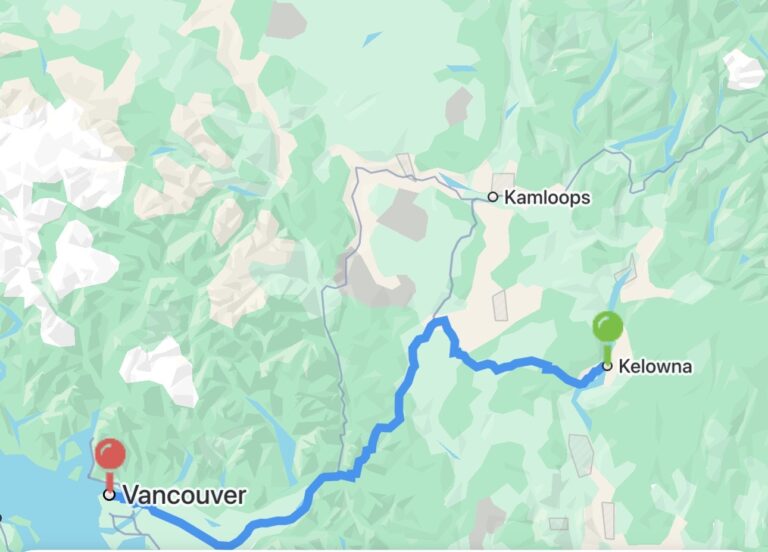
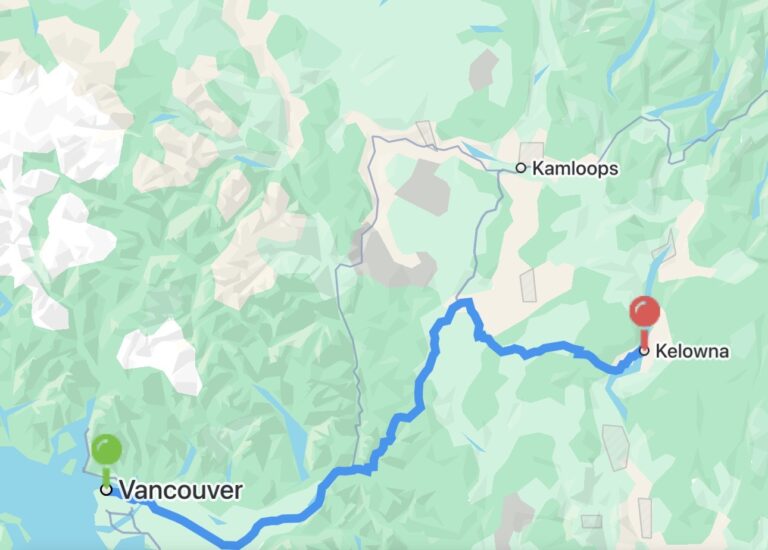
Vancouver to Kelowna is roughly 390 km and about four hours by road. Where a scheduled service exists on a corridor like that, it usually runs once or twice a day.
That is fine if your business fits the schedule. It is useless if it does not. A morning appointment can mean travelling the day before and paying for a night somewhere. A trip that fails to connect can turn a four hour drive into two days. Carpooling does not beat a bus on comfort, but it leaves when the driver leaves, and on a corridor with two departures a day that is the difference between going and not going.
Being new to BC is isolating before it is anything else
The practical problems get solved first. Somewhere to live, work, a bank account, a phone number. Knowing anyone takes considerably longer, and it is the part people are least prepared for.
Four hours in a car with someone travelling the same route does more for that than most deliberate efforts. Because CoTravel shows ratings and trip history, people who run the same corridors regularly end up travelling together more than once. If you are new to BC and your network is still small, the drive is one of the few settings where a real conversation happens by default.
When there is no car and no service
For anyone without a vehicle, the intercity gap is not an inconvenience. It is a wall.
A specialist referral in Vancouver when you live in Chilliwack or Squamish. An immigration or credential appointment that cannot be rescheduled. A shift starting before the first bus. Family landing at YVR at an hour when nothing runs. These are the trips that do not bend around a timetable.
A rideshare BC option is frequently the only thing available at the hour required. You need no Canadian licence, no insurance policy and no credit history to travel as a passenger, and in a province where establishing all three takes months, that matters more than the fare.
390 km, shared
The average vehicle on Canadian roads emits about 206 grams of CO2 per kilometre. Across the 390 km from Vancouver to Kelowna that works out to roughly 80 kg of CO2 one way, or about 160 kg for a return trip.
British Columbia has some of the most ambitious climate targets in the country and a transit network that cannot yet serve the distances between its cities. Until that changes, filling empty seats on trips that are already happening is the most direct saving available. Every rider who joins removes a second 390 km journey rather than making the same one more efficient.
Rideshare British Columbia: how CoTravel works
CoTravel is built for intercity travel rather than short urban hops, which fits the shape of the problem here. A driver already making the run posts their trip, including departure time, pickup area and seats available. Riders browse what is going, request a seat, and settle the fare in the app.
Every CoPilot and passenger is ID-verified and every trip is rated by both parties. You can read how we handle that on our Safety & Trust page.
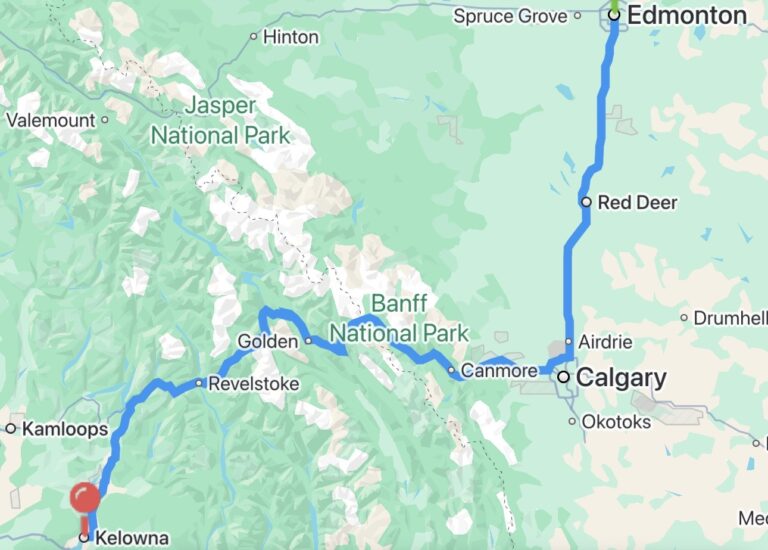
If you are travelling out of province, our guides to the Vancouver to Calgary carpool and the Vancouver to Edmonton carpool cover the two longest routes out of the Lower Mainland.
Living in British Columbia: common questions
What is the cost of living in British Columbia?
Monthly costs in BC in 2026 run from roughly $3,500 to over $8,800 depending on household size and where you live. Housing dominates. A one-bedroom apartment in Vancouver averages about $2,530, rising to around $3,220 in the city centre and falling to roughly $1,610 outside it. Vancouver rents are the second highest in Canada after Toronto.
How much is car insurance for a newcomer in BC?
ICBC quotes a first-time driver around $3,194 a year. The important detail is that you do not have to be treated as a first-time driver. ICBC will credit up to 15 years of driving experience from outside British Columbia, but only if you provide proof such as a driver abstract or an official letter from your previous licensing authority. Requesting that paperwork early is worth doing.
What are the transportation options in BC without a car?
Metro Vancouver has one of the strongest transit systems in Canada through TransLink, and BC Transit serves many other communities. Between cities the picture is weaker. There is no meaningful passenger rail, private coach routes were reduced after Greyhound withdrew in 2018, and services often do not connect well enough to travel between cities in a single day.
How long do I have to exchange my licence in BC?
British Columbia gives new residents 90 days to exchange a valid licence from another country or province. Drivers from countries with reciprocal agreements can usually exchange without a road test. You do not need a licence at all to travel as a passenger.
How does a rideshare in BC work on CoTravel?
A driver already making the trip posts their departure time, pickup point and available seats. Riders browse trips, request a seat and agree the fare in the app. Every CoPilot and passenger is ID-verified and every trip is rated by both sides, so you know who you are travelling with before you get in the car.