Calgary to Kelowna is one of the more scenic long drives in Canada and one of the more demanding. Roughly 603 km through Banff, the Kicking Horse, Rogers Pass and Revelstoke before dropping into the Okanagan. It is a genuinely beautiful road and it is also seven hours of mountain highway, much of it under winter conditions for half the year.
CoTravel connects people already making that run with people who need to be at the other end of it. A calgary to kelowna carpool splits a long day and a full tank, and puts a second person in the car on a route where that matters more than it does on the prairie.
How Far Is Kelowna from Calgary?
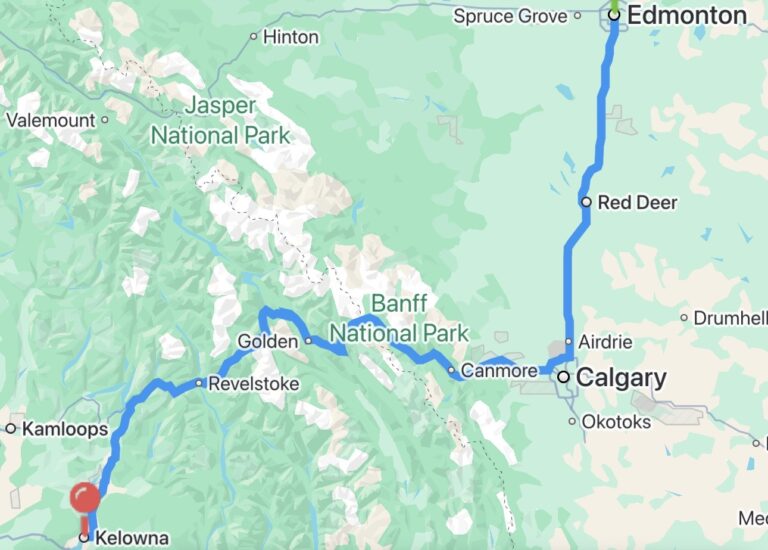
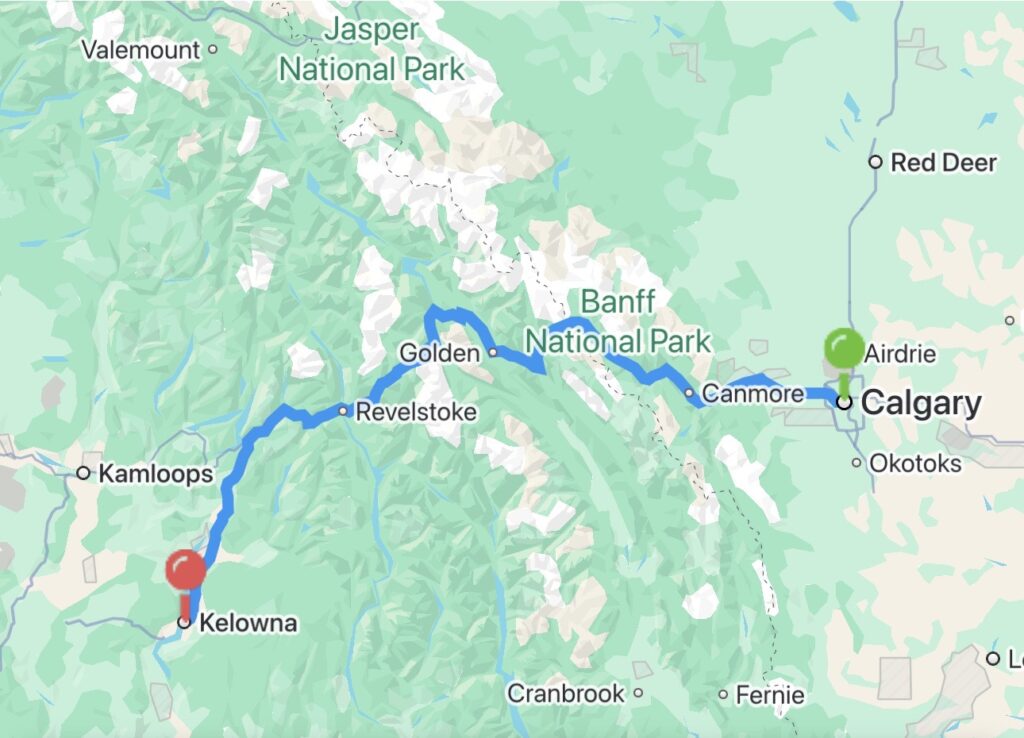
The calgary to kelowna distance is about 603 km by road. The standard route runs west on Highway 1 through Banff and Lake Louise, over the Kicking Horse Pass to Golden, through Rogers Pass and Revelstoke, then south at Sicamous onto Highway 97A which merges into Highway 97 down into the Okanagan.
Calgary to kelowna drive time is normally 7 to 7.5 hours without long stops. People ask how far is calgary from kelowna expecting a prairie number and are surprised by the answer, because the distance understates it. This is not a 603 km run across flat ground. It is three mountain passes, and the drive from calgary to kelowna takes considerably longer in winter or when construction is active through the Kicking Horse Canyon.
Calgary to Kelowna bus and train options
Both questions get asked constantly, and they have very different answers.
- Bus. Two operators run the calgary to kelowna bus daily. Ebus has the most departures at around four trips a day, taking roughly 10 hours 41 minutes. Rider Express averages about 10 hours 30 minutes, with a fastest service near 8 hours 35 minutes. Fares start around $57 and average closer to $93.
- Train. There is none. Kelowna has no passenger rail service and VIA Rail does not serve the Okanagan at all. A calgary to kelowna train does not exist, and studies about a future Okanagan rail line have not produced anything operating today.
- Flying. There are direct flights into Kelowna, which is the fastest option and usually the most expensive once you add airport parking or transfers at both ends.
So the honest answer to how to get from calgary to kelowna is that you have three real choices: fly, take a long bus, or travel from calgary to kelowna by car. Most people do the last one, and the calgary to kelowna by car option is the only one that leaves when you decide to.
Where the bus loses three hours
On paper the bus is a reasonable deal. In practice the gap is large. Driving takes about 7 hours. The bus takes about 10.5, and even the fastest scheduled service is 8 hours 35 minutes.
That is three and a half hours of your day on the standard service, each way. Add getting to the terminal, and getting from the Kelowna drop-off to wherever you are actually going, and a single trip absorbs most of a day either side. For a weekend in the Okanagan that is a meaningful share of the weekend. Sharing a car keeps the seven hour figure and drops you closer to the door.
Winter tires are not optional on this route
This is the part that catches people driving it for the first time, and it is worth stating plainly because it is enforced.
Tires rated M+S or carrying the mountain and snowflake symbol are required through Rogers Pass from 1 October to 31 March, with a legal minimum tread depth of 3.5 mm. Authorities can turn you around at the pass if your vehicle is not properly equipped. Rogers Pass is also one of the most avalanche-controlled stretches of highway in the world, and closures for control work are routine rather than exceptional.
If your car is not set up for that, and a lot of Calgary vehicles running all-seasons are not, riding with someone whose vehicle is properly equipped is a legitimate safety decision rather than only a financial one.
Parking at both ends
Downtown Calgary parkades typically run $12 to $18 a day, with on-street rates between roughly $2.50 and $6 an hour depending on zone. That applies to anyone coming the other way for a few days of appointments.
The larger parking cost on this corridor is the airport. For people who would otherwise fly, long-term parking at either end accrues for every day of the trip, and a weekend quickly becomes a three figure total once you add it to the fare. A passenger in a shared car pays none of it, and two people arriving together pay one parking fee rather than two.
Seven hours is a long time alone
This is a drive that rewards company. The scenery carries the first couple of hours, and then you are three passes deep with a long way still to go. Doing it alone twice in a weekend is genuinely tiring, and fatigue on mountain highway in poor light is a different proposition from fatigue on Highway 2.
Sharing it changes the trip. Someone to talk to, someone who notices when you have gone quiet, someone to take a turn on the return leg. Because CoTravel shows ratings and trip history, people who run this corridor regularly for work, family or the Okanagan in summer tend to end up matched with the same handful of riders over time.
When there is no car and the bus does not fit
For anyone without a vehicle, the options on this corridor are thin. There is no train. Flights are expensive if booked late. The bus runs, but on a schedule that assumes your day is flexible and takes ten and a half hours when it is not.
Students moving between Calgary and UBC Okanagan, seasonal workers heading to the Okanagan for the summer, people visiting family, and anyone attending an appointment that will not move all run into the same wall. A rideshare calgary to kelowna seat is often the only option that departs at the hour actually needed, and it asks for no licence, no insurance policy and no credit history from the passenger.
603 km, shared
The average vehicle on Canadian roads emits about 206 grams of CO2 per kilometre. Over the 603 km between Calgary and Kelowna that is roughly 124 kg of CO2 one way, or about 248 kg for a return trip.
That is one of the largest single-journey figures of any route we cover, and this corridor runs heavily in both directions through summer. Filling an empty seat on a trip already happening removes a second 603 km journey outright. On a drive this long, that saving is far larger than anything achievable by driving more carefully.
How the Calgary to Kelowna rideshare works on CoTravel
CoTravel is built for long intercity trips rather than short urban hops, which suits a seven hour mountain run well. A driver already making the trip posts their route, including departure time, pickup area and seats available. Riders browse what is going, request a seat, and settle the fare in the app.
Every CoPilot and passenger is ID-verified and every trip is rated by both parties. You can read how we handle that on our Safety & Trust page.
If you are only travelling the first leg, our Calgary to Canmore carpool guide covers the run into the mountains, and the Vancouver to Calgary carpool route covers the longer trip through BC. You can browse everything moving through the city on the CoTravel in Calgary hub.
Calgary to Kelowna Carpool FAQ
How far is Kelowna from Calgary?
The calgary to kelowna distance is about 603 km by road. The usual route runs west on Highway 1 through Banff, Lake Louise, Golden and Revelstoke, then south at Sicamous on Highway 97A which merges into Highway 97 into the Okanagan. Calgary to kelowna drive time is typically 7 to 7.5 hours without long stops.
Is there a bus from Calgary to Kelowna?
Yes. Two operators run daily service. Ebus has the most departures at around 4 trips a day, taking roughly 10 hours 41 minutes. Rider Express averages about 10 hours 30 minutes, with its fastest service around 8 hours 35 minutes. Fares generally start near $57 and average closer to $93.
Is there a train from Calgary to Kelowna?
No. Kelowna has no passenger rail service at all, and VIA Rail does not serve the Okanagan. Anyone searching for a calgary to kelowna train will find that the only options are driving, the bus, flying, or sharing a ride. Rail plans for the valley have been studied but nothing currently operates.
Do I need winter tires to drive from Calgary to Kelowna?
Yes, for a large part of the year. Tires rated M+S or carrying the mountain and snowflake symbol are required through Rogers Pass from 1 October to 31 March, with a legal minimum tread depth of 3.5 mm. Authorities can turn you around at the pass if your vehicle is not properly equipped, so this is enforced rather than advisory.
How does a Calgary to Kelowna carpool work on CoTravel?
A driver already making the trip posts their departure time, pickup point and available seats. Riders browse trips, request a seat and agree the fare in the app. Every CoPilot and passenger is ID-verified and every trip is rated by both sides, which matters on a seven hour mountain drive.