
Most articles about moving to Alberta are written for people still deciding. This one is not. It assumes you are already here, the boxes are mostly unpacked, and you have run into the thing nobody warns you about: Alberta is a province built entirely around owning a car, and you may not have one yet.
You are far from alone in that. Alberta took in 11,139 immigrants in the first quarter of 2026 and has led the country in interprovincial migration for fifteen straight quarters. The population passed five million this year. A lot of people are working out the same problem at the same time.
What living in Alberta actually costs to get around
The headline numbers on the cost of living in Alberta are reasonable by Canadian standards. Estimates for 2026 put a single person at roughly $2,395 a month, a family of four at about $5,275, and a one-bedroom apartment averaging near $1,450. Alberta also charges only the 5% federal GST with no provincial sales tax, which is a genuine advantage on everything you buy.
Transport is where it turns. Alberta has the second-highest car insurance premiums in Canada, averaging around $1,835 a year according to the province’s own Automobile Insurance Rate Board, and rates rose more than 20% year over year into 2026. That average assumes an established driving record. As a newcomer without Canadian driving history, you will usually be quoted well above it.
So the arithmetic for a lot of immigrants in Alberta looks like this: a used car, plus insurance priced as though you have never driven, plus fuel, plus parking. That is a significant monthly commitment in a first year when income is often still settling.
Transportation in Alberta: what exists and what does not
It is worth being precise about this, because transportation in Alberta is not uniformly bad. It is excellent in two places and thin everywhere else.
- Inside Calgary and Edmonton. Both have proper transit networks with LRT and buses, and monthly passes around $126. If you live and work in either city, you can manage without a car.
- Between cities. There is no passenger rail in Alberta. Intercity travel is served by private coach operators such as Red Arrow, Ebus, FlixBus and Rider Express, mostly on the Calgary–Edmonton corridor and on limited daily schedules.
- Everywhere else. Smaller centres like Red Deer, Lethbridge, Medicine Hat, Grande Prairie and Fort McMurray have some service, but often only a couple of departures a day. Rural Alberta has effectively none.
That middle and outer tier is the gap. If your job, your family or your appointments sit outside a single city, the schedule decides your day rather than you deciding it.
Parking is the cost you notice last
People budget for fuel and insurance. Parking is the one that accumulates quietly.
Downtown Calgary parkades typically run $12 to $18 a day, with on-street rates between roughly $2.50 and $6 an hour depending on zone. In Edmonton, EPark on-street rates run $1 to $3.50 an hour weekdays, rising to $4.50 in premium downtown zones like Rice Howard Way, with event-night rates at Rogers Place in the same range. Weekends are cheaper and statutory holidays are free, which helps if your schedule happens to fit.
Carpooling removes that line entirely for the passenger. Two people arriving in one car pay one parking fee instead of two, and a rider dropped at the door pays none.
The time a timetable takes from you
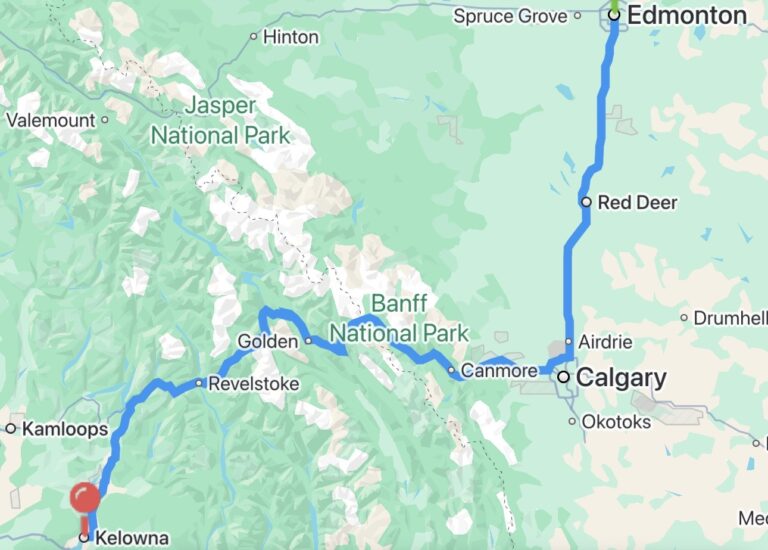
The Calgary–Edmonton run is about 300 km and takes roughly three hours by car. A scheduled coach is competitive on paper, but the coach only leaves when the coach leaves.
Add getting yourself to the terminal, waiting for a departure that may not match your appointment, and arranging onward travel from a central drop-off point, and a three-hour trip becomes most of a day. On routes with only one or two departures, a morning appointment can require travelling the night before. A carpool leaves at the hour you need and ends closer to where you are actually going.
The part nobody plans for: knowing people
Relocating to Alberta solves the practical problems first: somewhere to live, a job, a bank account. What takes far longer is having anyone to call.
Three hours in a car with someone going the same way does more for that than most deliberate attempts at it. People settling in Alberta on the same corridors tend to end up travelling together repeatedly, because CoTravel shows ratings and trip history and you can pick who you ride with. It is a small thing that compounds, and the people who use it most are the ones who mention it first.
When you have no car and no transit
For anyone without a vehicle, the gaps above are not an inconvenience, they are a hard limit. A specialist referral in Calgary when you live in Red Deer. A licensing or credential appointment in Edmonton. A shift that starts before the first bus. Family arriving at the airport at an hour nothing runs.
A rideshare Alberta option is often the only thing that reaches those hours. You do not need a Canadian licence, an insurance policy or a credit history to ride as a passenger, which matters in a province where all three take months to establish.
Fewer cars on Highway 2
The average vehicle on Canadian roads emits about 206 grams of CO2 per kilometre. Over the 300 km between Calgary and Edmonton that is roughly 62 kg of CO2 one way, or about 124 kg for a return trip.
Highway 2 is one of the busiest corridors in the country and most of those vehicles carry one person. Filling an empty seat on a trip already happening removes a second 300 km journey outright. On a drive that long, no amount of careful driving matches simply not making the trip twice.
How a carpool in Alberta works on CoTravel
CoTravel is built for intercity trips rather than short urban hops, which suits Alberta’s geography well. A driver already making the run posts their trip, departure time, pickup area, seats available. Riders browse what is going, request a seat, and settle the fare in the app.
Every CoPilot and passenger is ID-verified and every trip is rated by both parties. You can read how we handle that on our Safety & Trust page.
The busiest carpool Alberta corridor is the one between the two big cities. See Calgary to Edmonton and Edmonton to Calgary, and you can browse everything else on our main Alberta hubs, Calgary and Edmonton.
Moving to Alberta: common questions
Is Alberta good for immigrants?
Alberta has led the country in interprovincial migration for fifteen consecutive quarters and took in 11,139 immigrants in the first quarter of 2026 alone, so a great many people are making the same bet. Wages and sales tax compare well, since Alberta charges only the 5% federal GST with no provincial sales tax. The trade-off is that the province is built around driving, and the cost of running a car here is among the highest in Canada.
What is the cost of living in Alberta?
Estimates for 2026 put the cost of living in Alberta at roughly $2,395 a month for a single person and about $5,275 for a family of four. Housing is the largest line, with one-bedroom apartments averaging near $1,450. Transport is the one most people underestimate, particularly car insurance.
How do you get around Alberta without a car?
Calgary and Edmonton both have full transit systems with monthly passes around $126. Between cities, options are thinner: there is no passenger rail, and intercity coach routes are run by private operators like Red Arrow, Ebus, FlixBus and Rider Express on limited daily schedules. Outside the Calgary–Edmonton corridor, scheduled service drops off sharply, which is where carpooling tends to fill the gap.
How long do I have to exchange my licence in Alberta?
Alberta gives new residents 90 days to exchange a valid licence from another country or province. Drivers from countries with reciprocal agreements, including the US, UK, Australia, most EU nations, Japan and South Korea, can usually exchange without a road test. You do not need a licence at all to ride as a passenger.
How does a carpool in Alberta work on CoTravel?
A driver already making the trip posts their departure time, pickup point and available seats. Riders browse trips, request a seat and agree the fare in the app. Every CoPilot and passenger is ID-verified and every trip is rated by both sides, so you know who you are travelling with before you get in the car.